Posted on 16th February, 2026 in Blog posts
Rudolf Breslauer 1903-1945
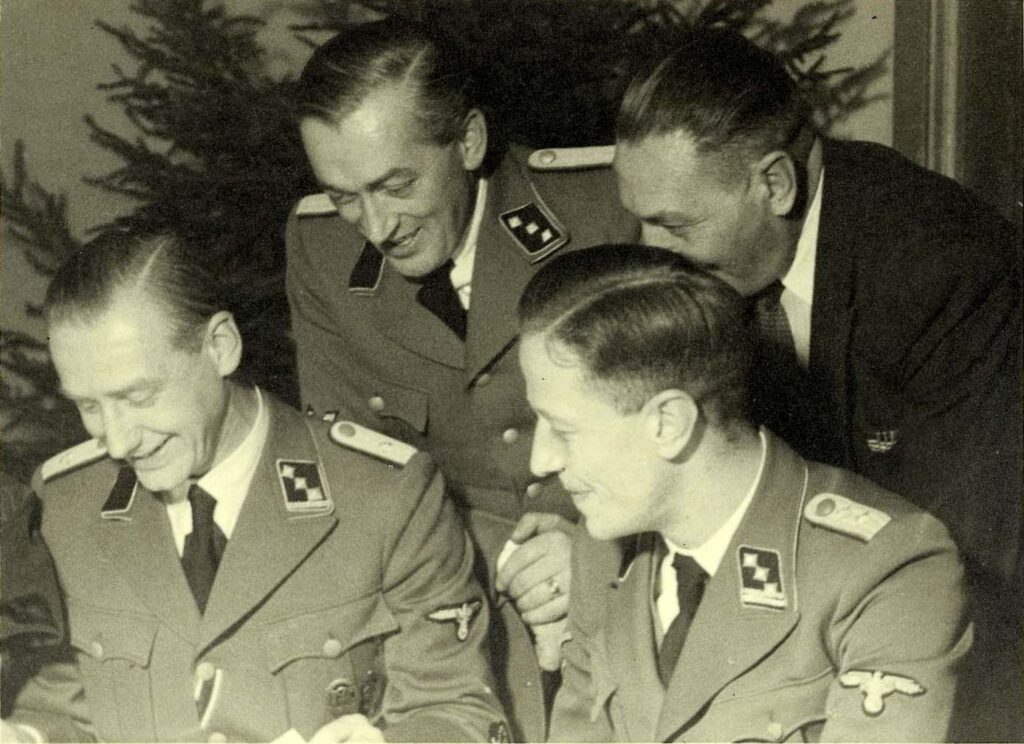
By chance I came across the story of German photographer Rudolf Breslauer a few days ago. A detainee himself, he was employed by the men in the photograph below to take pictures of life in the concentration camp they ran. And of those who were going to be murdered, including his own wife and children.
As the son of somebody who worked on MI9’s atrocities file during the second world war, I probably have an abnormal awareness of the holocaust. The question that is always raised in my mind when I come across some reference to that awful epoch is how ordinary men and women, such as those Berlin policemen described in Christopher R. Browning’s book Ordinary Men: Reserve Police Battalion 101 and the Final Solution in Poland , could undertake the monstrous tasks they executed. Communist stormtroopers were no different. Look at the 4 happy chaps admiring Breslauer’s photographs of misery.
As the years have gone by I have rubbed shoulders with many men who really do not care about anything except themselves and have no sympathy or empathy for other human beings at all, (although because our society demands it, they have to hide that), I realize that human beings who stand for a moral position or are altruistic when it is against their own interests, or just a nuisance, are really quite rare.
For the wicked, we cannot blame nationalism, exceptionalism or Islamism – ideology is just an excuse. The inquisition with its horrible cruelty, and pogroms of the Jews throughout Europe, were justified in religious terms but the torturers carried them out either because they were sadists or because they just didn’t care. For people who hate, just as for people who are indifferent, ideology or religion provide useful cover.
British Society has had its cruelties, but it also incubated, as this year’s Reith Lecturer Rutger Bregman has reminded us, a humane vision which had its earliest social manifestation in the campaign against the slave trade in the 18th and 19th centuries. The good people who made the suffering of others their concern and who urged their fellows to see the equality of humanity and our human rights came out of the relatively open and inclusive society incubated by Anglicanism. Rutger Bregman points out how important small groups of altruistic people have been and how that campaign against the slave trade has inspired hundreds, maybe thousands of altruistic movements from the early 19th century to our own day. They still find it hard to make way against the indifference of most of us and the justifications of the wicked.
That good people exist does not help us to understand why the perpetrators exist. Religion or racist or classist ideology are not the answer. A man became a church inquisitor in the 16th century, a witch burner in the 18th, a communist or Nazi mass murderer in the 20th, not because of the religion, but because he was foul. The religion provided the excuse, just as rules and commands (‘We must obey regulations/the law’) can be used by the cold hearted to condone causing pain. In a democratic or at least an open and tolerant society, a psychopath should be unable to express his wickedness and wreak his vengeance upon innocent victims. But, alas, then politicians may come along with their fantasies, to justify the expropriation and liquidation of available victims and give psychopaths – or just amoral men – their opportunity.
Rudolf Breslauer was employed by such men to record the transformation of people into victims, and, perhaps unexpectedly, their own indifference to suffering. Below is a picture of his employers enjoying his photos. Although Breslauer died at last, his photos survived. We can see them on the web – if we can bear to.